Football Ground Size: The Dimensions of the Beautiful Game
A football pitch is more than just a patch of grass—it is the stage upon which the world's most popular sport unfolds. Yet, surprisingly, there is no single "standard" size for a football ground. While the Laws of the Game provide a framework, pitches can vary significantly in their dimensions, creating unique characteristics that influence how the game is played.
A Brief History of Pitch Sizes
When football was first established in the United Kingdom, there were no markings to speak of, and pitch sizes were not standardised in any way. Players would simply use a suitably sized grassed area. In the early nineteenth century, corner flags were introduced to mark out the length and width of pitches, but it wasn't until the 1860s that lines began to be used to define touchlines and goal lines.
The modern football pitch as we know it today came into being in 1902, when updated rules stated that regulation pitches needed to have penalty areas, halfway lines and penalty spots, in addition to touchlines and goal lines. Since 1999, the Laws of the Game have preferred metric units, though imperial equivalents are still commonly used, particularly in the United Kingdom.
Official Dimensions: The Rules
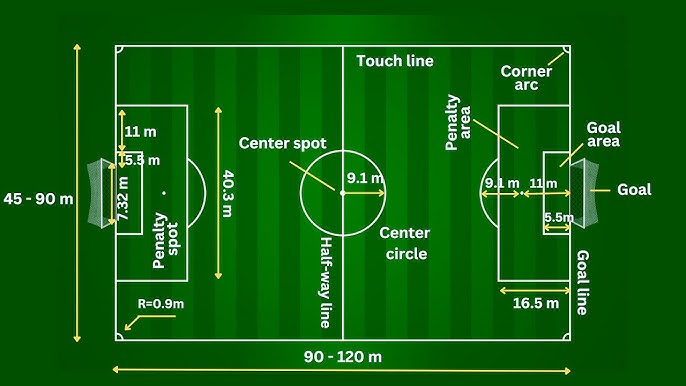
According to the Laws of the Game, a football pitch must be rectangular in shape. The longer boundary lines are called touchlines (or side-lines), and the shorter lines at each end are the goal lines.
For adult matches, the permitted dimensions are as follows:
| Measurement | Minimum | Maximum |
|---|---|---|
| Length (touchline) | 90 m (100 yds) | 120 m (130 yds) |
| Width (goal line) | 45 m (50 yds) | 90 m (100 yds) |
Crucially, the touchline must be longer than the goal line, ensuring the pitch is always rectangular rather than square.
International Matches
For international matches, the dimensions are more tightly constrained:
| Measurement | Range |
|---|---|
| Length | 100–110 m (110–120 yds) |
| Width | 64–73 m (70–80 yds) |
FIFA's Recommendation
While the rules allow for variation, FIFA's recommended field of play dimensions are 105 metres x 68 metres. This 105m x 68m size is the standard used in most top professional leagues, including the Premier League. The average Premier League pitch measures approximately 114 x 74 yards (104 x 68 m).
Pitch Markings
A football pitch is defined by its markings, each with specific dimensions and purposes:
- Centre Circle – A circle with a radius of 9.15 m (10 yds) marked around the centre spot.
- Penalty Area (18-yard box) – Extends 16.5 m (18 yds) into the field from the goal line and the same distance from either side of the goalposts along the goal line.
- Goal Area (6-yard box) – Extends 5.5 m (6 yds) into the field from the goal line and the same distance from either side of the goalposts.
- Penalty Spot – Marked 11 m (12 yds) away from the centre of the goal.
- Corner Arcs – Quarter circles with a radius of 1 m (1 yd) from each corner flag.
- Goal Dimensions – 7.32 m (8 yds) wide by 2.44 m (8 ft) high.
- Line Width – All lines must be the same width, not exceeding 12 cm (5 ins).
Surrounding Areas
Beyond the field of play itself, FIFA recommends additional space for player safety. At least two metres of level surface should be provided beyond each touchline and goal line. For larger stadiums, FIFA recommends five metres beyond each goal line and four metres beyond each touchline before the placement of perimeter advertising boards. For smaller stadiums, the recommendation is four metres behind each goal line and three metres beyond each touchline.
Pitch Sizes by Age Group
Full-size senior pitches are too big for children, so the FA has set out recommended dimensions for youth football:
| Age Group | Format | Pitch Length | Pitch Width |
|---|---|---|---|
| U7/U8 | 5v5 | 40 yds (36.6m) | 30 yds (27.4m) |
| U9/U10 | 7v7 | 60 yds (54.9m) | 40 yds (36.6m) |
| U11/U12 | 9v9 | 80 yds (73.2m) | 50 yds (45.7m) |
| U13/U14 | 11v11 | 90 yds (82.3m) | 55 yds (50.3m) |
| U15/U16 | 11v11 | 100 yds (91.4m) | 60 yds (54.9m) |
| U17+ | 11v11 | 110 yds (100.6m) | 70 yds (64.0m) |
Futsal: A Different Game Entirely
Futsal, the small-sided variant of football played on hard surfaces, has its own distinct dimensions. For international matches, the pitch must be 38–42 m in length and 20–25 m in width. The goals are smaller too—3 m wide by 2 m high.
Why Size Matters
The variation in pitch dimensions is not merely an administrative detail—it has a real impact on how the game is played. Wider pitches favour teams that like to use the full width of the field, stretching the opposition and creating space for wingers. Narrower pitches can benefit teams that prefer a more compact, defensive style. Even within the Premier League, pitch sizes vary, with some grounds being up to 96% of the area of a standard 105m x 68m field.
This flexibility, enshrined in the Laws of the Game, is a unique feature of football. Unlike sports with rigidly fixed playing areas, football allows for a degree of variation that adds to the tactical richness and character of the game—from the tight confines of a small ground to the expansive spaces of a vast international stadium.